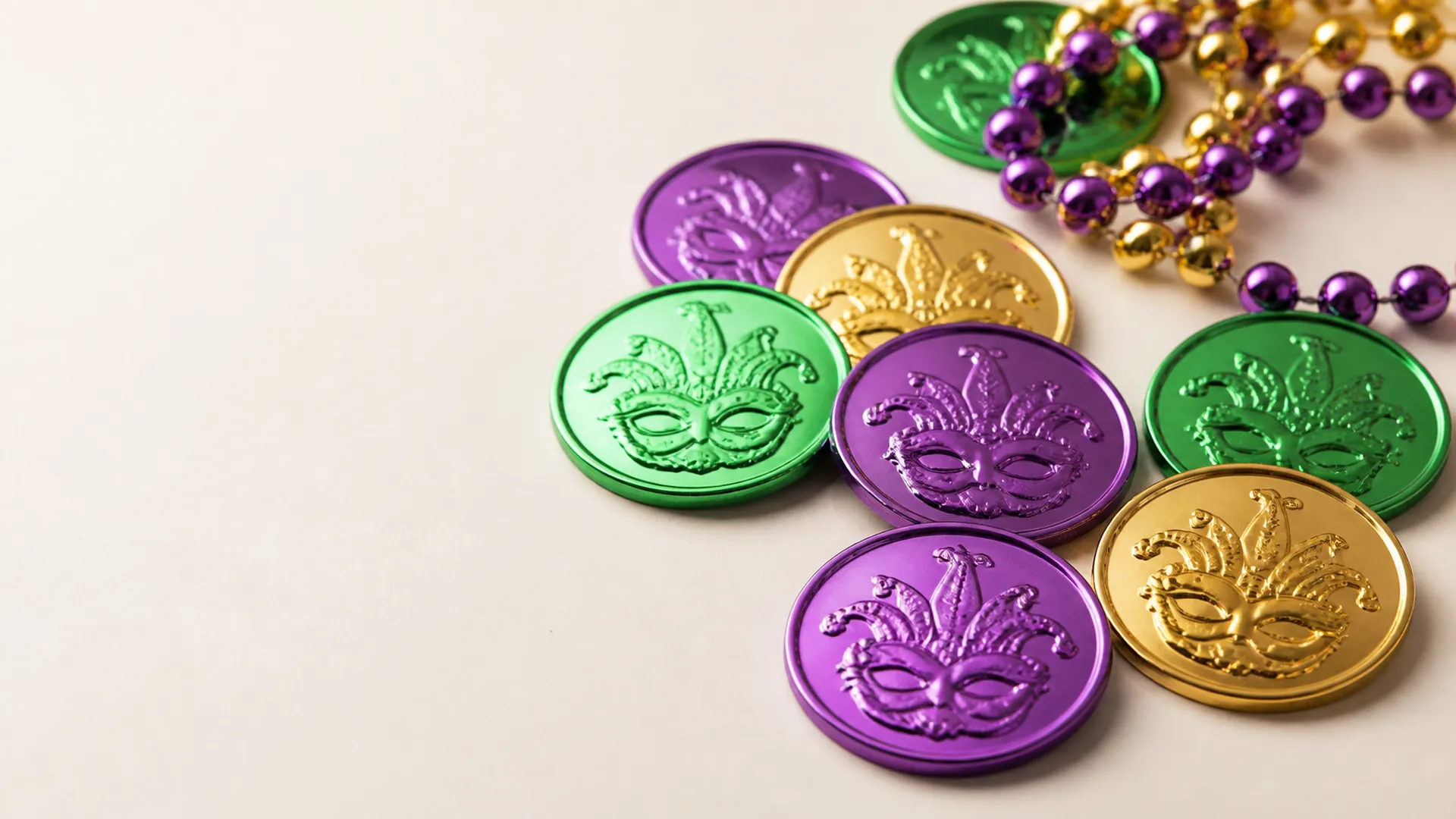
Quick answer: Mardi Gras doubloons are coin-like medallions that krewes throw from floats or give to members. They began in 1960, when artist H. Alvin Sharpe designed aluminum doubloons for the Krewe of Rex. A krewe doubloon usually shows the krewe's emblem on one side and the year's parade theme on the other.
The Historic New Orleans Collection notes that a collector market for doubloons grew up in the 1960s and that many New Orleans attics still hold binders of them. This guide covers where they came from, the difference between throw doubloons and keepsake doubloons, how to lay out the design, and what to send when you start.
Key takeaways
- The first Mardi Gras doubloons were thrown by Rex in 1960.
- Throw doubloons are light aluminum. Keepsake doubloons can be copper, silver or gold.
- Heavier metal pieces are for handing out, not throwing.
- The classic layout: krewe emblem on one side, parade theme on the other.
Where Mardi Gras doubloons came from
The Rex Organization credits New Orleans artist H. Alvin Sharpe with creating the doubloon. Sharpe convinced Rex's captain, Darwin Fenner, that lightweight aluminum medallions bearing Rex's image and seal would suit the krewe. The first order was for 80,000 plain aluminum coins, left undated in case the crowds didn't like them (Rex Organization, "The Rex Doubloon: Fifty Years", as of October 2026).
The Historic New Orleans Collection says Sharpe's 1960 piece for Rex was the first Mardi Gras doubloon, and that Rex also ordered 29 silver doubloons for special members of the krewe that year (HNOC, as of October 2026). Sharpe famously proved the light coins were safe by tossing a handful at Fenner, according to the same account.
Rex says its doubloons were given a gold anodized finish in 1962, and that other parading krewes soon followed with their own. Some accounts give different first-order numbers; we've used the figures from Rex and HNOC.
Throw doubloons vs. keepsake doubloons
That first Rex order already shows two kinds of doubloon: thousands of light aluminum pieces for the crowd and a small run of silver ones for members. The same split is still a useful way to plan.
Throw doubloons
- Thrown from floats to parade-goers.
- Traditionally aluminum, because it is light enough to throw safely.
- Often anodized in colors. New Orleans & Company notes that some krewes, such as Bacchus, assign different doubloon colors to different riders (New Orleans & Company, as of October 2026).
Keepsake doubloons
- Given by hand to members, royalty, officers, sponsors or guests.
- Made in heavier metals such as copper, silver or gold.
- Often finished to bring out detail and presented in a capsule or box.
Hart Strike Mint works in copper, silver and gold. Those metals are much heavier than aluminum, so we recommend them for keepsake doubloons that are handed out, not thrown into crowds. If your krewe needs throw doubloons, raise it in your project review.
How to lay out a krewe doubloon
The classic layout goes back to that first Rex piece: the krewe's identity on one side and something about the year on the other.
Obverse (krewe side):
- the krewe's emblem or seal;
- the krewe name;
- the founding year, if the krewe uses it.
Reverse (theme side):
- an illustration of the year's parade theme;
- the theme title;
- the Carnival year.
Additional ideas for keepsake pieces:
- the king's and queen's names, or the captain's year;
- a numbered edition for members;
- a color-filled emblem in purple, green and gold (see our guide to colored coins).
Keep text short. Doubloon designs are busy, and the theme title often has to share space with a detailed scene.
Plan the calendar early
Carnival dates are fixed by the calendar, so your doubloon deadline is too. The reverse design depends on the year's theme, so the theme has to be settled before the artwork can be finished. Start the review as soon as the theme and emblem artwork are ready. Price and timing are confirmed for each project, so ask early rather than assume.
Permissions
The krewe's emblem and name belong to the krewe. The person placing the order should be authorized by the krewe's captain or board. If the theme artwork includes characters, logos or artwork owned by someone else, get written permission first.
What to send
- Krewe name, emblem artwork and the year's theme.
- Whether the doubloons are keepsakes, throws or both.
- Your preferred metal: copper (see copper resources), silver (see silver resources) or gold.
- Quantity (minimum 250 pieces) and when you need them.
- A short design brief; our guide on writing a custom coin design brief shows what to include.
Frequently asked questions
When were Mardi Gras doubloons first thrown?
In 1960. New Orleans artist H. Alvin Sharpe designed aluminum doubloons for the Krewe of Rex, which threw them at Mardi Gras that year, according to Rex and The Historic New Orleans Collection.
What are Mardi Gras doubloons made of?
Parade throw doubloons are traditionally lightweight aluminum, often anodized in colors. Keepsake doubloons for members or royalty can be made in heavier metals such as copper or silver.
Can you make doubloons to throw from floats?
Hart Strike Mint works in copper, silver and gold, which are much heavier than aluminum. We recommend those metals for hand-presented keepsakes, not for throwing into crowds. Ask in your review if you need a throw piece.
What goes on a krewe doubloon?
The classic layout puts the krewe's emblem on one side and the year's parade theme on the other. Add the krewe name, the year and the theme title.
What is the minimum order for custom doubloons?
Every Hart Strike Mint order has a minimum of 250 pieces.
Start your krewe's doubloon
Send your krewe's emblem, this year's theme and how the doubloons will be used. We'll review the design, metal and format with you. Start a project review
Sources and further reading
All sources accessed October 30, 2026.