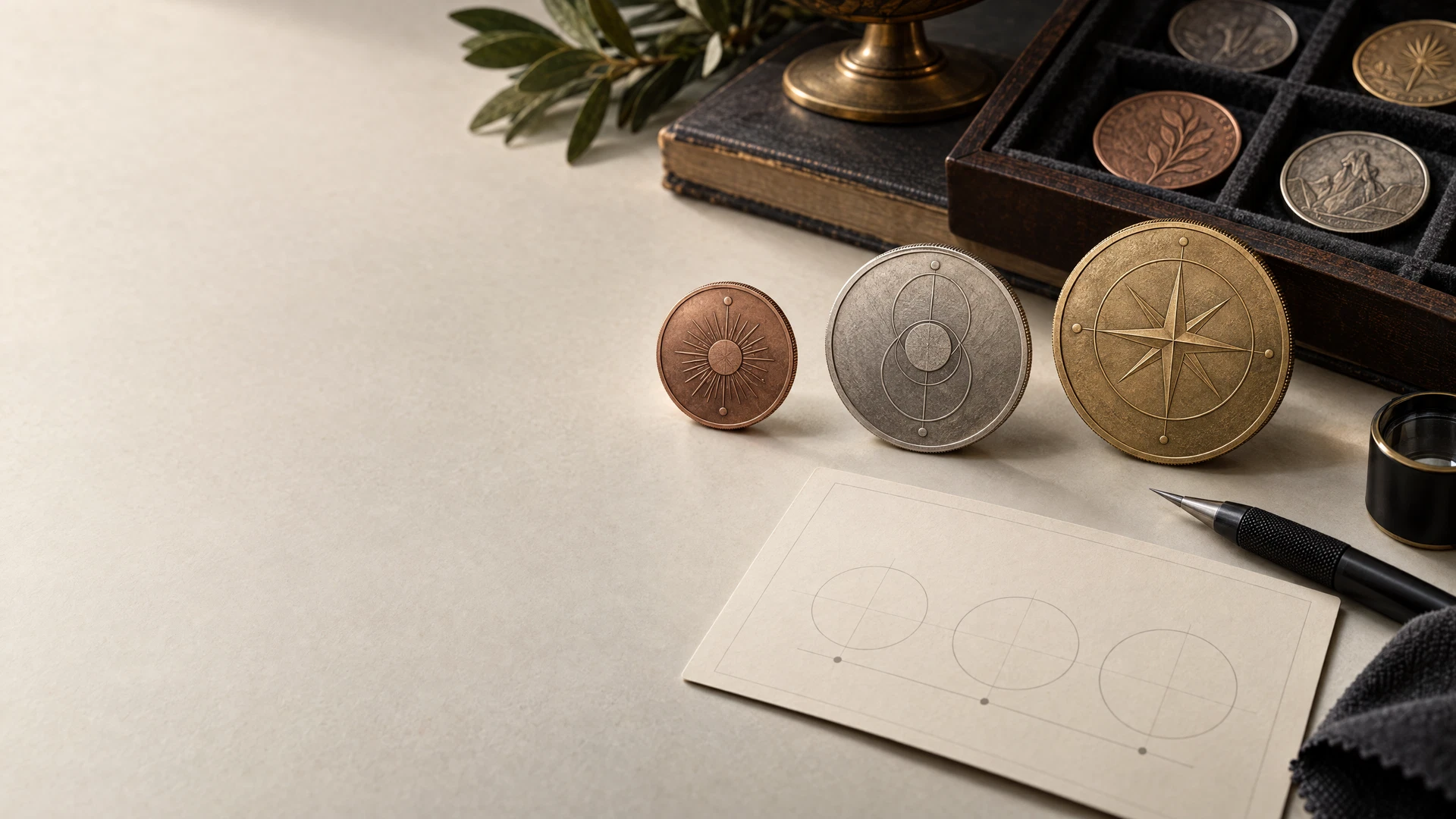
Mintage, edition, and numbering have separate jobs. A mintage is a stated count of pieces made; an edition identifies the release; and a serial number identifies an individual piece. The goal is a record a reader can understand later, not impressive wording.
Define the release, decide what will be stated publicly, and keep a master record that separates planned from completed quantities. Then coin mintage numbering is documentation, not a vague label.
Start with three distinct terms
A mintage answers a quantity question: how many pieces were made within a stated boundary? That boundary may be a design, date, version, material, or other feature. State it plainly. “Final mintage for the 2026 Harbor design” is clearer than an unexplained number beside a title.
An edition answers an identity question: which release does this piece belong to? It can be documented without serial numbers. A serial number is an individual identifier, such as 014 of 075. It can match a piece to a record, but it does not prove a wider production claim unless the record establishes that link.
- Mintage: the count, with its exact scope and status.
- Edition: the named or otherwise defined release.
- Serial number: the identifier assigned to one piece within a chosen system.
Do not confuse production, issue, and sales
Official records show why terms need context. The U.S. Mint uses “production” for circulating coins, “sales” for numismatic products, and “mintage” for bullion; its reports may later be updated. A number needs a measurement method and date. United States Mint production and sales figures
For a private collector release, separately record authorized, completed, set-aside, released, and removed pieces when relevant. They need not be the same. A running sales tally is not automatically a final production total.
- Planned quantity: an intention recorded before completion.
- Completed quantity: the reconciled count after production closes.
- Released quantity: the count made available in the stated context.
- Serial range: assigned identifiers, including voids or skips.
Build a record that can be checked later
A series record should be compact enough to maintain and specific enough to check. Give each release a stable name or code and record the facts that distinguish it. If a design changes, identify a new version or note the revision clearly. A dated record prevents later guesswork.
Even an official mintage depends on a stated scope. The Royal Mint’s circulating figures include pieces released into circulation and those requested from HM Treasury and held ready to enter it. Write your own scope plainly. Royal Mint UK circulating coin mintage figures
A practical release-record template
Use one page, spreadsheet row, or version-controlled document per release. Consistency matters more than polish; save a dated export when the record is finalized.
- Release name or code, series name, edition/version, and entry date.
- Design identifier and the artwork or version boundary.
- Count status—planned, in progress, final, or corrected—and effective date.
- Serial convention, range, voids, replacements, or “not individually numbered.”
- Public statement and a private note for any change or exception.
Numbering needs a rule before the first number is assigned
Choose a rule that still makes sense after the release ends. A consecutive sequence such as 001–050 is easy to explain. If the sequence resets for each edition or marks a set rather than one piece, say so. Do not let an internal identifier look like a final mintage.
Record exceptions: incorrectly marked pieces, damage, replacements, and unused numbers. A short master-record note is better than pretending the sequence has no history. Correct a public statement with a date and a brief explanation.
Write claims with the same precision as the record
A good public line says only what a reader can verify: “Edition record finalized on [date]; 48 pieces completed; individually identified 001–048.” If the count is open, call it planned. If identifiers are not used, say so.
Do not turn an edition or number into a claim about future demand, rarity, or resale. Records preserve provenance and reduce confusion; they do not guarantee an outcome. For context, browse the collector guides. For rights, approval, or tooling questions, review the project FAQ and obtain appropriate professional advice where needed.
Bring recordkeeping into the brief at the right time
Decide recordkeeping terms before descriptions, inserts, or announcements are drafted. Not every project needs serial numbers or a fixed mintage, but the project owner should decide what will be documented, who maintains the record, and how corrections are communicated.
For a collector-led metal project, use custom project planning to organize the larger brief. A project review can then address release context and questions requiring project-specific confirmation.
Frequently asked questions
Is an edition the same as a mintage?
No. An edition identifies a defined release; mintage describes a quantity within a stated scope. An edition may have no serial numbers, and a quantity statement should say exactly what it counts.
Does “numbered 1 of 100” prove that only 100 pieces exist?
No. It shows an identifier and denominator, but the record must say whether 100 is planned or final, which version it covers, and how voids or replacements are handled.
Should a collector release have a final mintage before it is announced?
State a final mintage only when quantity and scope are final. Otherwise label the count planned or in progress and date the statement.
What should happen when a series record needs a correction?
Keep the original entry, add a dated correction, and explain the change narrowly. Preserve the revised public wording with the master record.
A project conversation
Make the release record part of the project brief
If your collector-led concept needs a clear edition boundary or documented numbering approach, bring that context to the first conversation. Specifications and terms remain project-specific.
Start a project reviewClosing perspective
Clear series records need defined terms, a stated scope, a date, and one source of truth. Those basics separate an edition label, a production count, and an individual identifier.
Keep the record honest about what is planned and what is final. That gives a collector-led release useful history without promises the documentation cannot support.